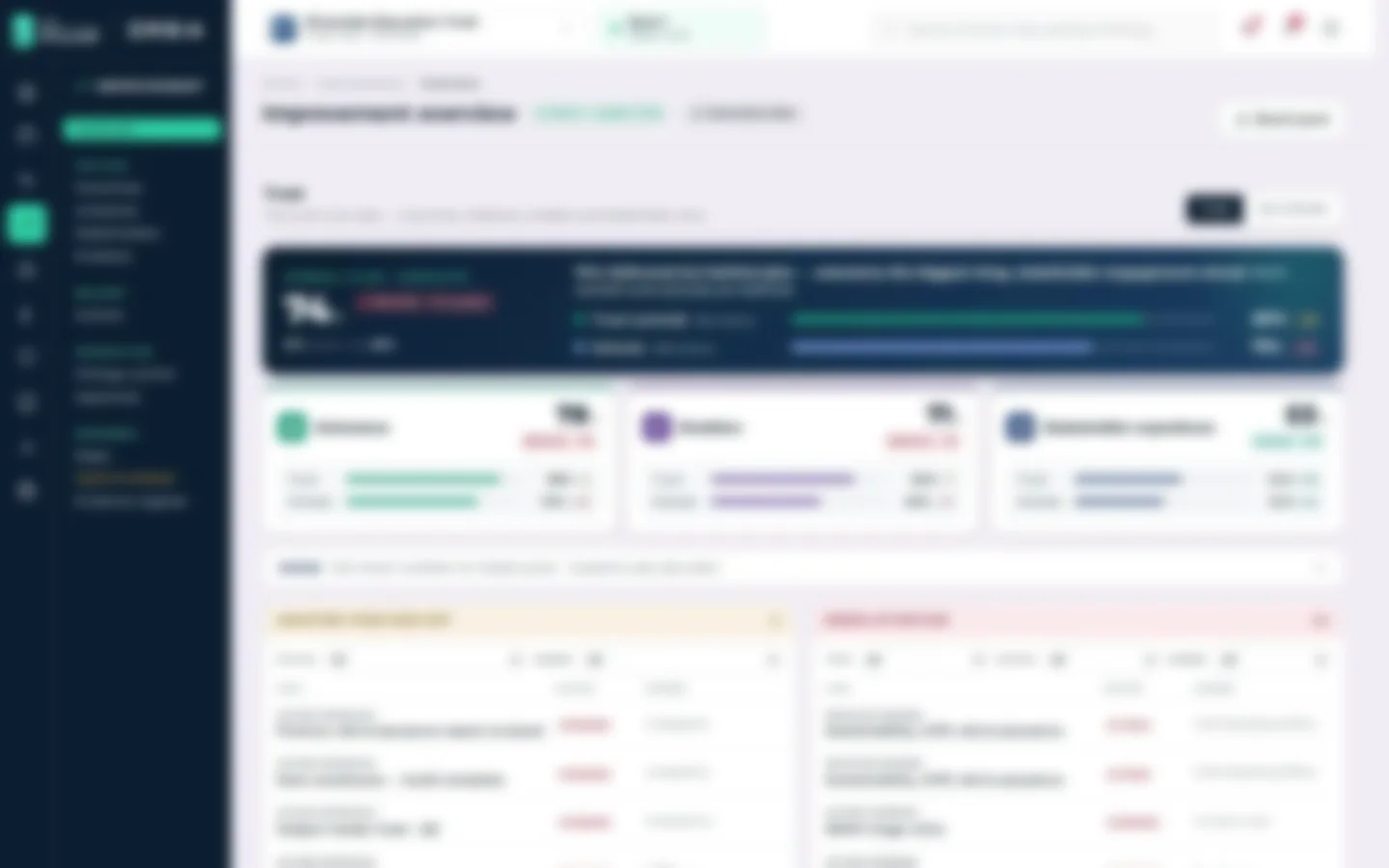
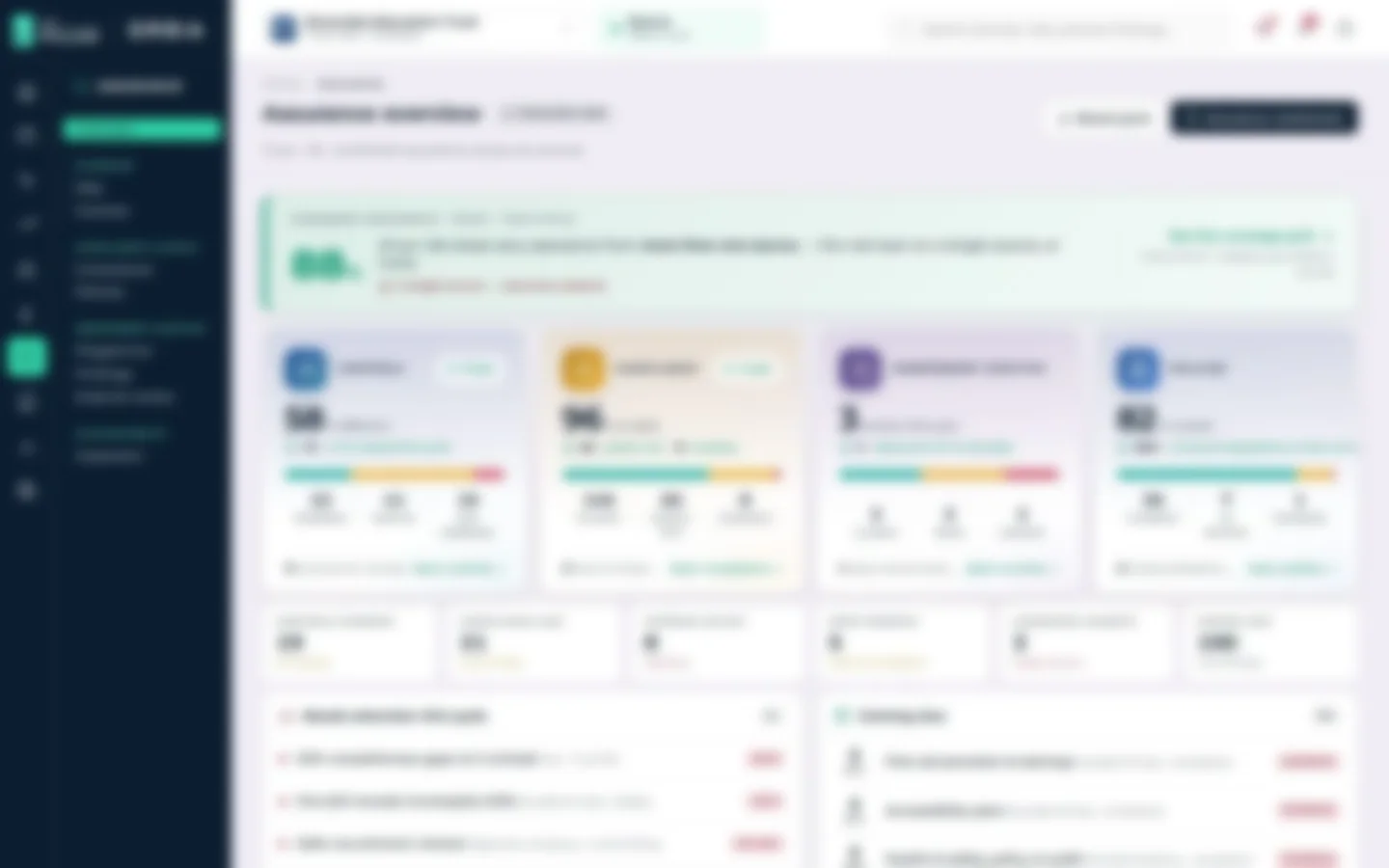
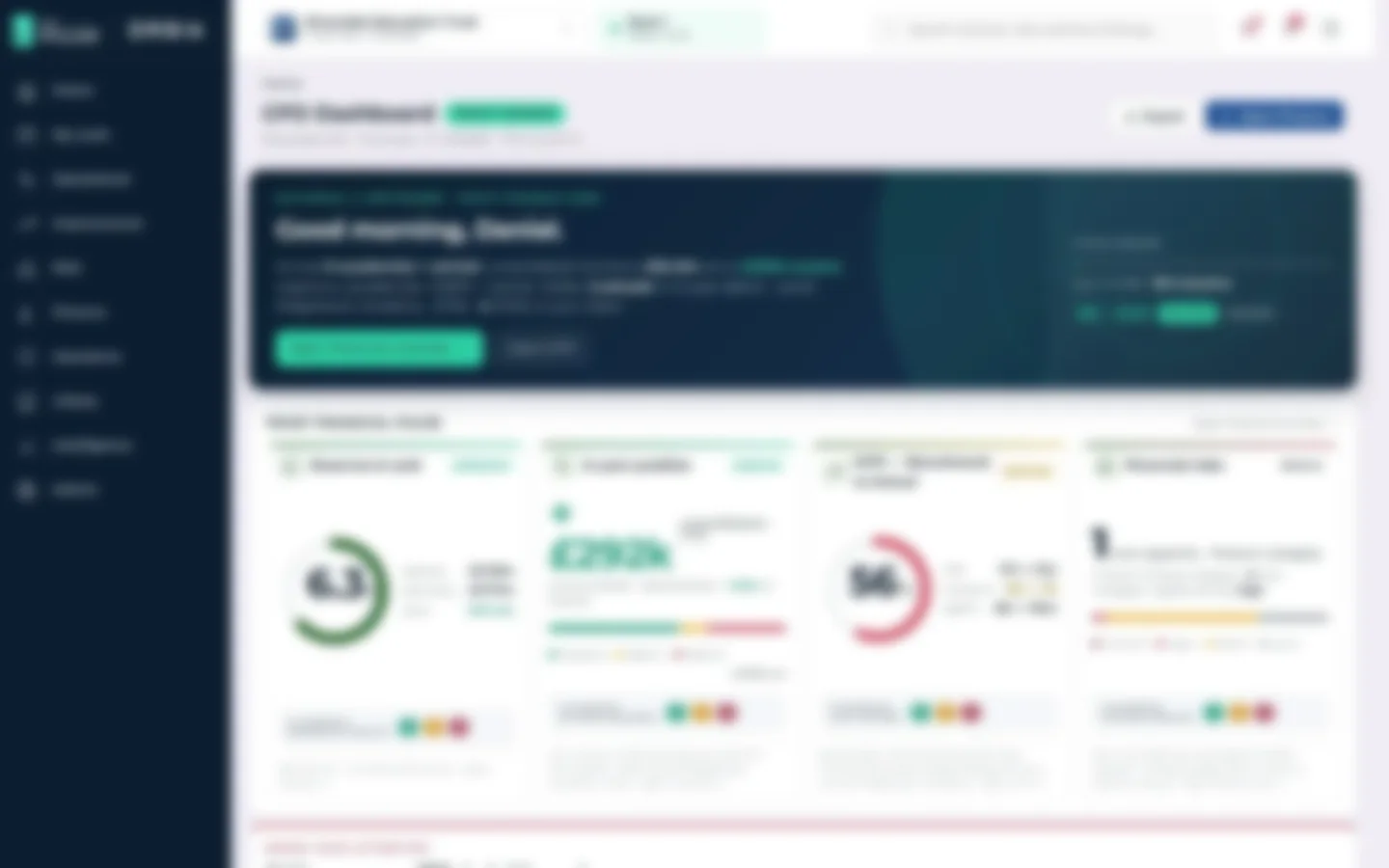
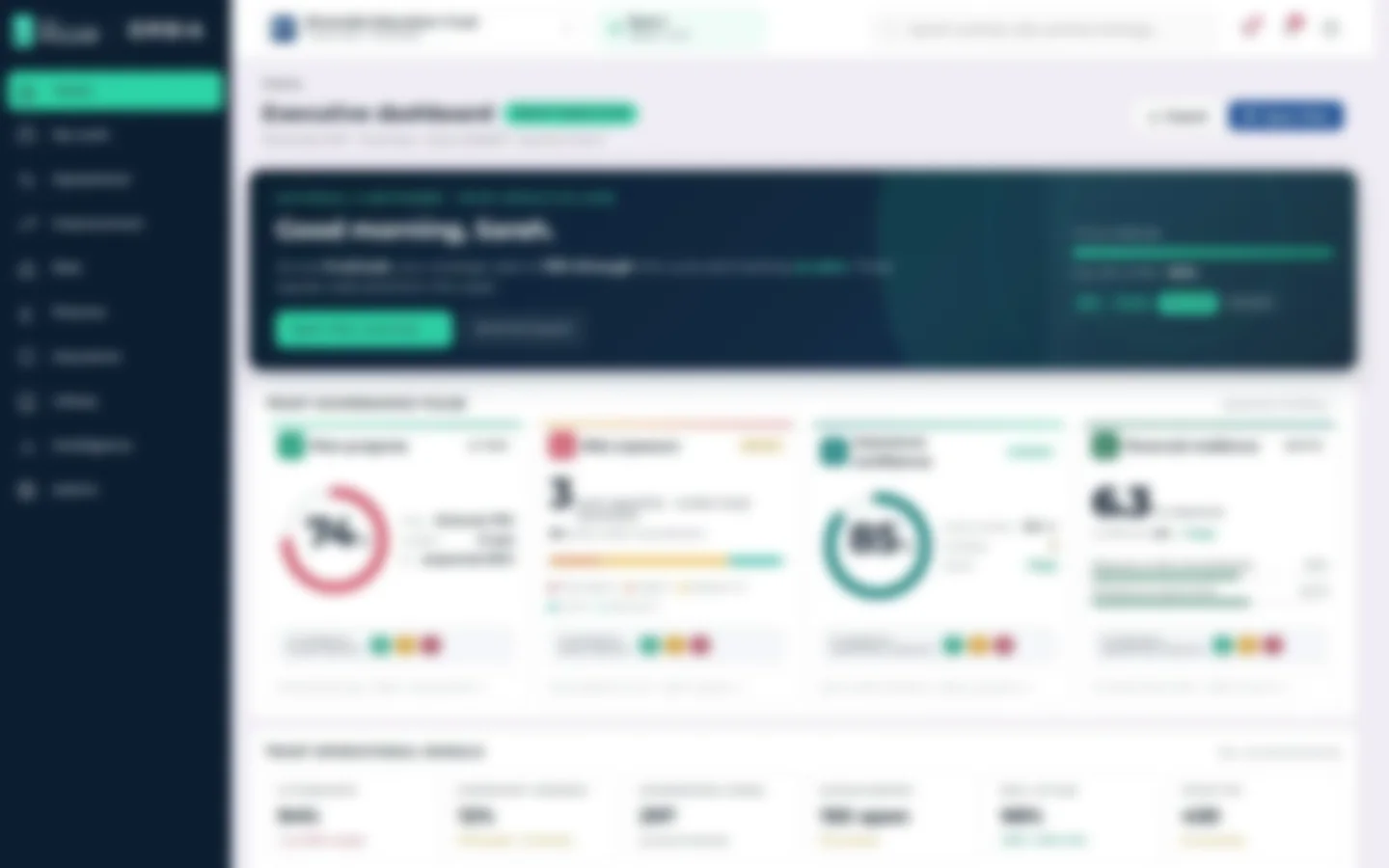
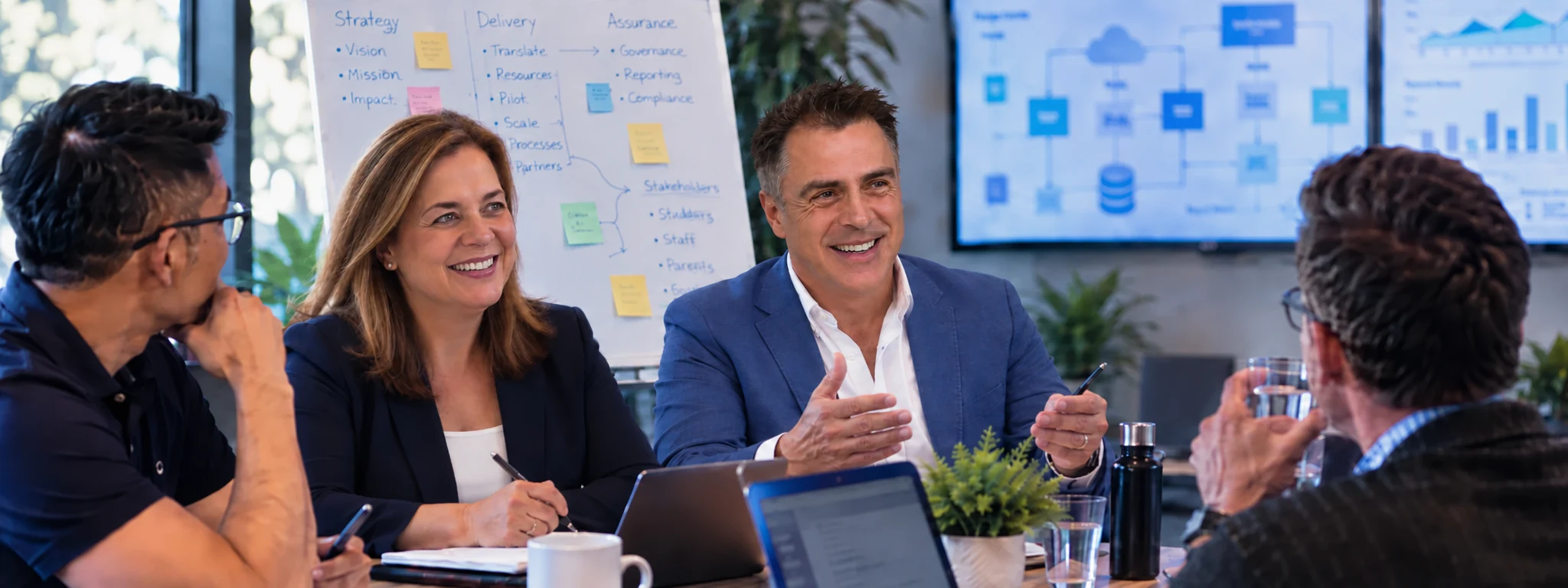
Where are we going? Are we getting there? Can we afford it? What could stop us? How do we know?Strategy, improvement, finance, risk, assurance and governance, in one model at last.
Every trust is already answering the six questions, in a strategy document, an improvement plan, a budget workbook, a risk register, evidence folders for the auditors and a board pack that takes a week to put together. Each is fine. None of them connects to the others, so the board sees fragments, the executive joins them by hand, and the schools see something different again.
Trustees, executives and headteachers looking at the same picture. That is the change.
Strategy sets the outcomes. The improvement plans serve them. The money is read against the plans. The risks are tied to the plans. The assurance is tied to the risks and the controls. And governance sees all of it as one live picture, for the trust and for every school in it.
Built from the data your systems already hold, not rebuilt by hand. Where something is not evidenced, ORSIA says so, never a made-up rating.
All six answers come from one picture. Change one thing, and they all move with it. Immediately.
Your strategy and the outcomes you have set, in your own words, at the top of the picture rather than in a document nobody opens.
Progress you can see as the work happens, for the trust and for every school, instead of a written report that is out of date by the meeting.
The money read against the plan rather than beside it, so the question is not what you spent but whether you can still do what you said you would.
The risks that actually matter, surfaced early enough that someone can still do something about them.
Assurance you can show rather than assemble, gathered as the work is done.
Decisions, owners and sign-offs in one place, so nothing depends on remembering who said what.
Four of the six sit behind a duty the Academy Trust Handbook places on the board. The risk register and the board’s ultimate oversight of it. A programme of internal scrutiny over financial and non-financial controls. Curriculum and financial planning read together. The accounting officer’s annual statement on regularity. ORSIA does not make a trust compliant, and no platform can. It makes the answers available.

Every trust sets outcomes for its pupils. ORSIA keeps those outcomes at the top of the picture and reports movement against them, so the board's attention stays on what the trust exists to do.
Every pupil, every phase, viewed against trust targets and the national picture.
Attendance, suspensions and the pupils most likely to fall out of view. How pupils with SEND fare against their peers, and what families say alongside what the numbers show, so a gap is seen rather than lost in an average.
Safeguarding, pupil voice and the culture of every school, with the early warning signs picked up before they show in the numbers.
Where pupils go next, and what that says about the curriculum and support the trust gave them.
Finances, operations, people and governance strong enough to absorb a shock and keep delivering for the next cohort, and the one after.
Outcomes are the trust's own, in its own words. ORSIA does not impose a framework. It makes the one you have visible.
Your trust already holds the information. What it does not have is one place where all of it means the same thing, stays current, and can be read by everyone who needs it.
Not a mirror of your systems. The layer above them.
What could stop us, answered on a trustee's phone.
When something matters enough to reach the board, it reaches the right trustee wherever they are, with their acknowledgement recorded against it. Not another email that may or may not have been read.
High risk escalated to the trust
Riverside Academy has escalated a risk for trust review. Open to read it.
High · Trust reviewRisk escalation approved
Approved for trust review.
Structured, staged and led by us. Nothing to replace, and nothing written back.
We agree what success looks like in your terms, and take an honest baseline of how things work today. Nothing is designed before we know what we are designing for.
Your platform is stood up and connected to the systems you already use. Most of this work is ours, behind the scenes.
Before you rely on anything, your board sees the picture and signs off on evidence. Then we stay close while the new way of working becomes the way you work.
Your MIS, ledger and HR system stay exactly as they are. ORSIA is the layer above the record.
ORSIA Connect reads one way. Your source systems remain the single point of truth.
A security briefing, procurement note, DPIA and data-processing agreement, ready for the people who will ask.
What we ask of you: a senior lead who can make decisions, some of your team’s time, and a willingness to move the work out of Word and Excel. We will be specific about the rest when we talk.

ORSIA is not a reporting layer laid over the old way of working. The improvement plan stops being a Word document, the risk register stops being a spreadsheet, and the board pack stops being something someone pulls together the week before the meeting. Your teams do the work in the platform, once, and everything above it is generated from that. Papers you can still amend where judgement is needed, but never have to assemble. It is a change, and we say so up front, because it is also where the time comes back.
| Today | In ORSIA |
|---|---|
| The board pack assembled by hand in the week before the meeting | Papers that come out of the live picture, amended where judgement is needed |
| The risk register in a spreadsheet, written up before the committee | A register that moves as the work does, because the work happens in the platform |
| The improvement plan in a Word document, refreshed each term | A plan you can see progress against without writing a progress report |
Three examples of many, and every trust starts from a different place. In a demo we take the ones that matter most to you. Book a demo
You will not be starting from a blank page. Every trust begins with an honest baseline of how things work today, agreed with you, so that the first things we improve are the ones that matter most to your trust.
Take risk. Most trusts keep a register in a spreadsheet and review it before the committee. Done properly it takes less effort to run than the spreadsheet did, not more, because the discipline is applied once and read by everyone. The same is true of assurance, of improvement planning and of the governance cycle. Capability goes up and the hours go down.

The idea goes back to 2017, when Emma first wrote about how everything a school does in governance, education and operations ends up in pupil outcomes. We both had other jobs, and we kept coming back to it, each time with more of the problem in view. ORSIA is what nine years of that became.
The joining up is the hard part. Each of those things is well understood on its own. Making them answer to one model, in one language, so that a change in any of them shows up properly in the others, is where the years went.
ORSIA is led by its founders and built by a team that spans the disciplines a platform like this needs. Sector knowledge decides what it must do. Product and engineering decide how. Data, security and design decide whether a board will trust it and the people running a trust and its schools will use it.
The direction, the roadmap and what gets built next, led by the founders and shaped by what trusts actually need.
Led by Emma, from her own years as an executive school leader and from many conversations with school business leaders, CFOs, CEOs and trustees. What a trust needs, what a board will read and what a school will actually do.
The platform itself, and the engineering discipline a system a board relies on has to be built with.
ORSIA Connect: getting a trust’s own data in safely, and making it mean the same thing everywhere.
Data protection, access control, the legal surface and the assurance a trust's DPO and auditors will ask for.
Every screen tested with the people who will use it, from a trustee acknowledging a risk escalation on their phone to a CFO reading the finance paper before committee.
Designed around how a MAT genuinely runs, with people who have run schools and trusts and who support them now.
The whole trust in one picture, strategy through to outcomes, and the early warning before the surprise.
Finance read with delivery and risk, not beside them, and the reserves position of every school, live.
Every school's operational picture against the thresholds you set, and the actions that follow, owned and chased.
Assurance you can see, not just receive, readiness for inspection and audit at any moment, and an escalation on your phone when it matters.
Cycles, decisions and sign-offs in one place, and papers that come from the picture rather than a week of chasing.
Statutory assurance against the clocks, and the pupils most at risk of falling out of view, school and trust.
Book a personalised demo and see how ORSIA would work in your trust.
No. The papers come out of it, but the point is the model underneath, the one place where strategy, improvement, finance, risk, assurance and governance are connected. A reporting tool shows you what happened. ORSIA shows you whether you are getting where you meant to go, what could stop you, and how you know.
The papers do come out of it, produced from the live picture and still editable where a human judgement belongs. But the papers are the by-product, not the point.
No, not by itself. Escalation makes a school’s risk visible and accountable at trust level without moving ownership. It stays where it is, with the people who manage it.
Taking it onto the trust’s own register is a separate and deliberate decision. Whether a risk escalates at all is decided by the trust’s own appetite and escalation rules, not by us.
ORSIA does not make a trust compliant, and no platform can. What it does is make the duties evidenceable. The Handbook requires the board to own the risk register, to run a programme of internal scrutiny over financial and non-financial controls, to plan curriculum and finance together, and to sign an annual statement on regularity. ORSIA holds those in one connected model with named owners, dates and evidence attached, so what the board attests to is visible as the year goes rather than assembled at the end of it. The 2026 edition takes effect on 1 October 2026.
ORSIA Connect reads from the systems your trust already uses, one way and read-only, for every school and the trust. Nothing is written back, and your source systems stay the point of truth.
Structured, staged and led by us, with your board signing off before you rely on anything. We agree the pace with you at the start and will walk you through exactly how it runs when we talk.
Data, engine and logic stay on a secured server in the UK/EEA. The interface is display-only, with role-based access and a full audit log of who viewed, changed or approved what. A completed DPIA and data-processing agreement come as standard.
No. ORSIA is the layer above the record. It connects the systems a trust needs to keep and removes the fragmentation it no longer needs.
Through a compliant route your governance team can adopt, with a board paper to support it. Talk to us and we will walk you through it.